- English
- Español
- Português
- русский
- Français
- 日本語
- Deutsch
- tiếng Việt
- Italiano
- Nederlands
- ภาษาไทย
- Polski
- 한국어
- Svenska
- magyar
- Malay
- বাংলা ভাষার
- Dansk
- Suomi
- हिन्दी
- Pilipino
- Türkçe
- Gaeilge
- العربية
- Indonesia
- Norsk
- تمل
- český
- ελληνικά
- український
- Javanese
- فارسی
- தமிழ்
- తెలుగు
- नेपाली
- Burmese
- български
- ລາວ
- Latine
- Қазақша
- Euskal
- Azərbaycan
- Slovenský jazyk
- Македонски
- Lietuvos
- Eesti Keel
- Română
- Slovenski
- मराठी
- Srpski језик

How Does a Stenter Machine Improve Fabric Quality and Production Efficiency?
Article Summary: A stenter machine plays a critical role in textile finishing by controlling fabric width, drying, and heat-setting processes. This article explains how stenter machines work, their core components, technical parameters, and how they solve common production challenges such as fabric distortion, uneven drying, and low efficiency. It also provides practical guidance for selecting the right equipment and maximizing operational performance.
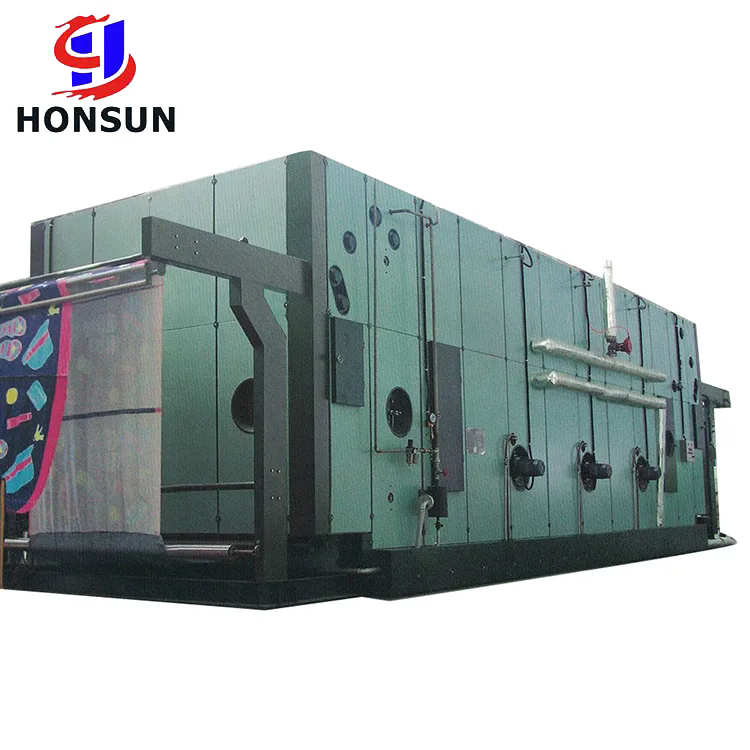
Table of Contents
1. What Is a Stenter Machine? 2. How Does a Stenter Machine Work? 3. Key Components of a Stenter Machine 4. Technical Parameters and Specifications 5. Benefits of Using a Stenter Machine 6. Common Problems and Solutions 7. How to Choose the Right Stenter Machine 8. Frequently Asked Questions
1. What Is a Stenter Machine?
A stenter machine is an essential textile finishing device used to dry, stretch, and stabilize fabrics after wet processing stages such as dyeing or washing. It ensures that the fabric maintains consistent width, smoothness, and dimensional stability.
In modern textile manufacturing, achieving precise fabric finishing is critical. Without proper tension control and heat-setting, fabrics may shrink, wrinkle, or lose structural integrity during subsequent processing or end use.
Key Function: The stenter machine simultaneously controls fabric width, applies heat, and removes moisture to achieve uniform finishing results.
2. How Does a Stenter Machine Work?
The working principle of a stenter machine involves mechanical stretching combined with controlled heating. Fabric is fed into the machine and guided through a series of clips or pins that hold its edges firmly.
- Fabric enters through a padding or feeding system
- Edges are gripped by clips or pins on chains
- The fabric is stretched to the desired width
- Hot air circulates through chambers for drying and heat-setting
- Fabric exits with stabilized dimensions
Temperature, airflow, and speed are precisely controlled to ensure optimal finishing. This process is especially important for synthetic fabrics, where heat-setting defines long-term dimensional stability.
3. Key Components of a Stenter Machine
A high-performance stenter machine consists of several integrated systems designed for precision and efficiency.
- Feeding Unit: Ensures uniform fabric entry
- Clipping/Pinning System: Holds fabric edges securely
- Chain Rail System: Controls fabric width and movement
- Heating Chambers: Provide uniform hot air circulation
- Exhaust System: Removes moisture and fumes
- Control Panel: Allows parameter adjustments
Advanced machines from manufacturers such as Hongshun integrate automation systems, enabling precise control over temperature profiles and fabric tension.
4. Technical Parameters and Specifications
| Parameter | Typical Range | Description |
|---|---|---|
| Working Width | 1800 – 3600 mm | Maximum fabric width processed |
| Temperature Range | 100°C – 220°C | Heat-setting and drying temperature |
| Machine Speed | 10 – 100 m/min | Production speed capability |
| Heating Method | Gas / Steam / Electric | Energy source for heating chambers |
| Chambers | 4 – 10 sections | Number of drying zones |
These parameters can be customized depending on fabric type, production scale, and process requirements.
5. Benefits of Using a Stenter Machine
Investing in a high-quality stenter machine provides multiple operational advantages.
- Improved Fabric Quality: Ensures consistent width and smooth surface
- Dimensional Stability: Prevents shrinkage and distortion
- High Production Efficiency: Continuous processing reduces downtime
- Energy Optimization: Modern systems reduce heat loss
- Versatility: Suitable for cotton, polyester, blends, and technical textiles
For textile manufacturers facing quality inconsistencies, a properly configured stenter machine is often the most effective solution.
6. Common Problems and Solutions
Despite its advantages, improper operation or outdated equipment can lead to production issues.
| Problem | Cause | Solution |
|---|---|---|
| Uneven Drying | Airflow imbalance | Adjust fan speed and airflow distribution |
| Fabric Shrinkage | Incorrect temperature | Optimize heat-setting parameters |
| Edge Damage | Clip misalignment | Maintain and calibrate pin/clip system |
| High Energy Consumption | Poor insulation | Upgrade insulation and heat recovery system |
Routine maintenance and proper calibration significantly reduce these risks.
7. How to Choose the Right Stenter Machine
Selecting the right stenter machine requires a detailed evaluation of production needs.
- Fabric Type: Different materials require different temperature ranges
- Production Capacity: Match machine speed with output goals
- Energy Efficiency: Consider long-term operational costs
- Automation Level: Advanced control systems improve consistency
- After-Sales Support: Reliable technical support ensures uptime
For a deeper overview of machine configurations, visit the official product page: Stenter Machine Product Details
Manufacturers like Hongshun offer customizable solutions tailored to different textile production environments, ensuring optimal performance and return on investment.
8. Frequently Asked Questions
Q1: What fabrics can be processed using a stenter machine?
A: Stenter machines are suitable for cotton, polyester, nylon, blended fabrics, and technical textiles.
Q2: Why is heat-setting important?
A: Heat-setting stabilizes fabric structure, preventing shrinkage and deformation during use or washing.
Q3: How can energy consumption be reduced?
A: Using heat recovery systems, optimizing airflow, and maintaining insulation can significantly lower energy usage.
Conclusion
A stenter machine is a cornerstone of textile finishing, delivering consistent quality, improved efficiency, and long-term fabric stability. By understanding its working principles, technical parameters, and optimization strategies, manufacturers can significantly enhance production outcomes.
If you are looking for a reliable and high-performance solution, Hongshun provides advanced stenter machines tailored to modern textile demands. Contact us today to explore customized solutions and improve your production efficiency with expert support.